Description
My review, as published in the AR, June 2009:
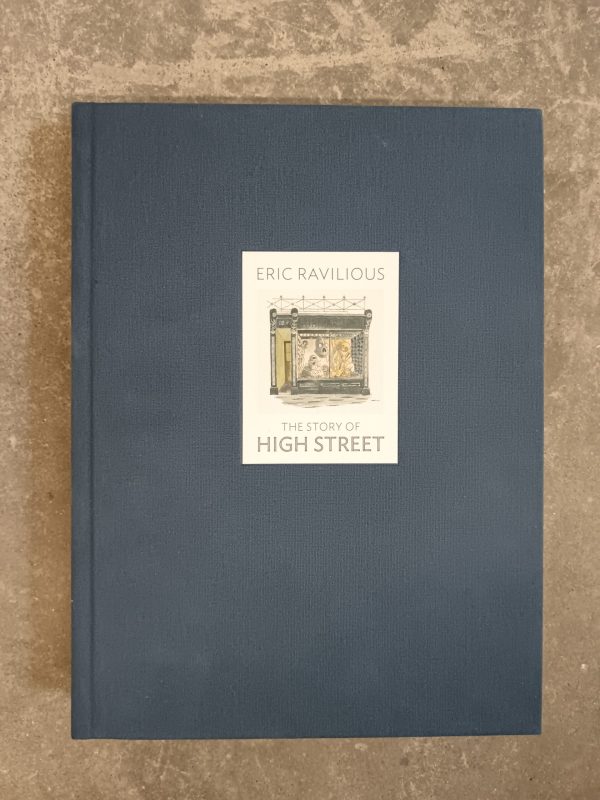
High Street was a children’s book published in 1938 by Country Life Publications. It was artist Eric Ravilious’s creation, with accompanying text by James Richards, editor of the Architectural Review between 1935 and 1972. According to Richards’s autobiography, Ravilious was his closest ever friend. Not only did the war kill Ravilious tragically young, but it also destroyed the original book’s lithographic plates and so only 2000 copies were ever printed. This, along with the fact that Ravilious’s drawings are an extraordinary talent pushing the limits of a new printing technology, mean that the original book has become a collector’s item. The book under review, Eric Ravilious: The Story of High Street, is printed in an even more limited edition (750 copies), albeit priced slightly cheaper (a ‘mere’ £160). It contains a faithful reproduction of the original book, along with two essays of appreciation by Alan Powers and James Russell. Powers sets the book suitably in an art history context and Russell fascinatingly traces the 24 shops that Ravilious drew and documents their current state. The family butcher, for example, “is now Elite Hair Design, where you can lie on a sunbed in a back room that still has meat hooks hidden above the ceiling.”
The original High Street proved more interesting reading than I expected. It is a unique snapshot of a lost England on the eve of World War II. High Street celebrates the lost age of the butcher, the baker, and if not the candlestick maker, then the more whimsical Submarine Engineer and even Fire Engineer and their respective shop fronts. Like in the 1970s cartoon Mr. Benn, a shop-keeper magically appears and we are transported briefly to another life. A life where shops’ displays are affected by the seasons and where each shop smells pungently different to the next. But this is also the age of Metroland and the increased popularity of personal transport which have ultimately led to the big four supermarket chains dominating the shopping and suburban experience. Despite Richards’s literal mind, when he wrote in his introduction of the benefits of the efficiency and standardisation of the newer chains that were then taking over the traditional shops in the high street, he cannot have imagined the cloned monotony of anywheresville today. Ultimately, High Street invites questions about what a high street should be, as a place for people and their activities, rather than cars. In this respect, there is something of the shock of the old about it.
Limited edition of 750 copies. Navy cloth lettered in silver with a printed paper label to the upper board. In navy card slipcase as issued. Illustrated throughout in colour and black and white. Fine in good condition slipcase.
Free shipping to UK – please request a quote for overseas.